Showing posts with label Snakes. Show all posts

Saturday, September 6, 2014

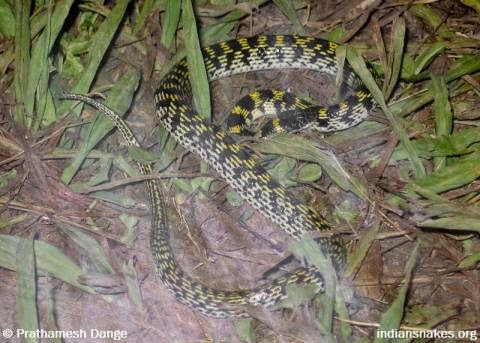
Zaw's Wolf Snake ( Lycodon zawi Slowinski, Pawar, W, Thin, Gyi, Oo & Tun, 2001 )


Zaw's Wolf Snake ( Lycodon zawi Slowinski, Pawar, W, Thin, Gyi, Oo & Tun, 2001 )


Scientific Name:
Lycodon zawi (Slowinski, Pawar, W, Thin, Gyi, Oo & Tun, 2001)
Zaw's Wolf Snake - Zaw's Wolf Snake : Full body profile
Distribution:
In India it has been recorded from Assam, Manipur, Meghalaya, Mizoram, Tripura.
Family:
Colubridae
Characteristics for identification:

Looks close to Common Wolf. In Lycodon zawi (Lycodon zawi) loreal scale does not touch internasal while in Lycodon aulicus (Common Wolf) loreal always in contact with internasal. Bands in Lycodon zawi are lesser in number which do not spread on side dorsals. Head of Locodon aulicus is more flatter and in most cases, the band will be present on the neck too.
Description:

Dorsal body-
Body slender with shiny smooth scales of same size. Dorsal colour glossy brown. Milky white or yellowish-white cross bands from posterior of neck upto end of tail where they usually become faint.

Ventral body -
Belly creamy white with darker edge. Subcaudal scales paired in a zigzag manner.

Head -
Head depressed and broader than neck. Upper lip color brown or lighter than dorsal color. Eyes entirely black.

Tail -
Normal length tail with faint bands; ends with pointed tip.
Hide Scalation
Head:
Supralabial 8 or 9; 3rd to 5th in contact with eyes; preocular 1; loreal 1, not in contact with internasal; postocular 1 or 2; temporal 2+3, 1+2, 2+1, 2+2 or 3+4.
Dorsal:
Smooth scales in 17:17:15 rows.
Ventral:
179-207; angulated laterally; anal divided.
Sub Caudal:
45-75; paired.
Diet:
Feeds on geckos and skinks.
Hide Look Alike
Common Wolf Snake

Mountain Worm-Eating Snake ( Trachischium monticola Cantor, 1839 )

Mountain Worm-Eating Snake ( Trachischium monticola Cantor, 1839 )


Scientific Name:
Trachischium monticola (Cantor, 1839)
Show Synonyms
Lama Camp, Arunachal Pradesh

Distribution:
Family:
Natricidae
Characteristics for identification:

This species is totally distinct from all other Trachischium species in following characters: 1) higher (15 vs 13 in all other) mid body dorsal rows. 2) Lowest range of ventral scales (113-125 in this species).
Description:

Description:
Maximum length- 25cm.

Dorsal body-
Body cylindrical with shiny smooth scales of same size. Dorsal color light or dark brown with blackish longitudinal lines; two more usually faint reddish or light stripes found laterally.

Ventral body -
Belly color yellowish.

Head -
Head depressed on snout; not broader than neck. Upper lip color brown or lighter than rest of head. Eyes with rounded pupil. One yellowish spot may also present on each side on neck.

Tail -
Short length tail ends with conical tip.
Hide Scalation
Head:
Supralabial 6; 3rd & 4th in contact with eyes; prefrontals 2, preocular 1; loreal 1, postocular 2, rarely united; temporal 1+1.
Dorsal:
Smooth scales in 15: 15: 15 rows without apical pits.
Ventral:
113-125; anal undivided.
Sub Caudal:
26-40; paired.
Hide Look Alike
Rosebelly Worm-eating Snake
Yellow-Belly Worm-Eating Snake
Black-Belly Worm-Eating Snake
Blyth's Reticulate Snake

Periyar Shieldtail ( Uropeltis madurensis Beddome, 1878 )


Periyar Shieldtail ( Uropeltis madurensis Beddome, 1878 )


Scientific Name:
Uropeltis madurensis (Beddome, 1878)
Show Synonyms
Distribution:
Family:
Uropeltidae
Description:

Uropeltis madurensis can be diagnosed by the following combination of characters:

Part of rostral visible from above, not distinctly longer than its distance from frontal; rostral not fully separating nasals.
Dorsal uniform brown, each scale with a well defined lighter golden yellowish outline.
Ventral with alternate rhomboidal large brown and orange spots or blotches, the two colours of equal intensities.
Tail shield with clearly defined, thickened, circumscribed disc.
Hide Scalation
Head:
Rostral visible from above, not fully separating nasals; portion of rostral visible from above less than distance from frontal; nasals pierced by nostril, divided by rostral anteriorly but in contact with each other posteriorly; prefrontals slightly larger than nasals / oculars, subequal to frontal; frontal longer than broad, distinctly smaller than parietal; parietals large, largest of all head scales; a small rhomboid accessory scale just behind parietal; supralabials 4, 1st & 2nd ones small, 3rd below eye, 4th the largest; infralabials 3, elongate, 1st pair slightly curved anteriorly; mental scale small, subequal to 1st infralabial, but as wide as long.
Dorsal:
Dorsal scales in 17: 17: 15 rows.
Ventral:
144-157, angulate laterally; anal 2, right overlap left, each larger than a body scale.
Sub Caudal:
8-10 pairs + 1 terminal scale; tail shield distinctly truncate above, ridged and slightly concave; covered with 30, bi- and tri-carinate thickened scales; 7 scales across the length and 4–5 across the width of the disc.

Shortt's Shieldtail ( Uropeltis shorttii Beddome, 1863 )


Shortt's Shieldtail ( Uropeltis shorttii Beddome, 1863 )


Scientific Name:
Uropeltis shorttii (Beddome, 1863)
Show Synonyms
Distribution:
Family:
Uropeltidae
Description:

Uropeltis shorttii is diagnosed by the following combination of characters:

Part of rostral visible from above, not distinctly longer than its distance from frontal; rostral not fully separating nasals, shorter than rostral scale.
Dorsal dark blackish-brown with distinct yellow crossbars or annuli all over the body.
Ventral with alternate rhomboidal large yellow and black spots or blotches, the two colours of equal intensities.
Tail shield with clearly defined, thickened, circumscribed disc
Hide Scalation
Head:
Rostral visible from above, smaller than nasal, not completely separating nasals; nasals in contact with one another posteriorly, prefrontals not in contact with rostral, subequal in size to nasal and ocular scales; nasals pierced by nostril, divided by rostral anteriorly but in contact with each other posteriorly; prefrontals somewhat larger than nasals and oculars, subequal to frontal; frontal longer than broad, distinctly smaller than parietal; parietals large, largest of all head scales; supralabials 4, 1st and 2nd ones small, 3rd below eye, 4th the largest; infralabials 3, elongate; mental scale small, subequal to 1st infralabial, but as wide as long.
Dorsal:
Body scales imbricate, cycloid; dorsally around body in 19: 17: 17-15. rows;
Ventral:
141–156 (148.5±10.6), angulate laterally; anal 2, left overlap right; each larger than a body scale.
Sub Caudal:
10–12 pairs +1 terminal scale; tail shield distinctly truncate above, mildly concave, circumscribed and ridged; covered with 30–31 (30.5±0.7), bi- and tricarinate thickened scales; 10 scales across the length and 4–5 (4.5±0.6) across the width of the tail shield.

Red Spotted Royal Snake ( Spalerosophis arenarius Boulenger, 1890 )


Red Spotted Royal Snake ( Spalerosophis arenarius Boulenger, 1890 )


Scientific Name:
Spalerosophis arenarius (Boulenger, 1890)
Show Synonyms
Regional Names:
English:
Red Spotted Diadem Snake
Distribution:
Family:
Colubridae
Description:

TBA
Habitat:
Desert and semi-deserts.
Hide Look Alike
Black-headed Royal Snake
Glossy-bellied Racer

Sunday, August 31, 2014

Striped Trinket Snake ( Orthriophis taeniurus Cope, 1861 )


Striped Trinket Snake ( Orthriophis taeniurus Cope, 1861 )

Jerdon's Pit Viper ( Protobothrops jerdonii Günther, 1875 )


Jerdon's Pit Viper ( Protobothrops jerdonii Günther, 1875 )


Scientific Name:
Protobothrops jerdonii (Günther, 1875)
Subspecies Red Spotted Pit Viper, Protobothrops jerdonii xanthomelas Günther 1889

Distribution:
Venom Type:
Haemotoxic
Family:
Viperidae
Description:

TBA
Hide Look Alike
Himalayan Pit Viper

Himalayan Wolf Snake ( Lycodon mackinnoni Wall, 1906 )

 Himalayan Wolf Snake ( Lycodon mackinnoni Wall, 1906 )


Scientific Name:
Lycodon mackinnoni (Wall, 1906)
Show Synonyms
Regional Names:
English:
Mackinnon's Wolf Snake
Distribution:
Family:
Colubridae
Description:

TBA
Hide Scalation
Head:
Supralabial 8; 3rd to 5th in contact with eyes; preocular 1; loreal 1 or united with prefrontal (as in Type specimen), in contact with internasal; temporal 1+2 or 2+3.
Dorsal:
Smooth scales in 17:17:15 rows.
Ventral:
163-187; angulated laterally; anal divided.
Sub Caudal:
48-56; paired.
Hide Look Alike
Barred Wolf Snake

Rosebelly Worm-eating Snake ( Trachischium guentheri Boulenger, 1890 )


Rosebelly Worm-eating Snake ( Trachischium guentheri Boulenger, 1890 )


Scientific Name:
Trachischium guentheri (Boulenger, 1890)
Regional Names:
English:
Gunther’s Worm-eating Snake


Distribution:
Family:
Natricidae
Characteristics for identification:

This species can be identified by checking 1) Dark brown or reddish-brown dorsal. 2) Coral red belly. 3) Single prefrontal scale.
Description:

Maximum length- 52.5cm.

Dorsal body-
Body cylindrical with shiny smooth scales of same size. Dorsal colour dark brown or reddish-brown with or without dark or faint longitudinal stripes.

Ventral body -
Belly color coral red which is more prominently on posterior half.

Head -
Head depressed on snout; not broader than neck. Upper lip color brown or lighter than rest of head. Eyes with rounded pupil. Young individuals bear a yellow collar in faint form.

Tail -
Short length tail ends with conical tip.
Hide Scalation
Head:
Supralabial 6; 3rd & 4th in contact with eyes; preocular 1; loreal 1, postocular 1; temporal 1+2.
Dorsal:
Smooth scales in 13: 13: 13 rows without apical pits.
Ventral:
132-154; anal undivided.
Sub Caudal:
30-43; paired.
Habitat:
Found in high elevation zones of Himalayan foothills. Lives in moist deciduous forests.
Diet:
Feeds on earthworms and insects.
Hide Look Alike
Yellow-Belly Worm-Eating Snake
Mountain Worm-Eating Snake
Black-Belly Worm-Eating Snake
Blyth's Reticulate Snake

Wall's Shieldtail ( Brachyophidium rhodogaster Wall, 1921 )

 Wall's Shieldtail ( Brachyophidium rhodogaster Wall, 1921 )


Family:
Uropeltidae
Characteristics for identification:

Can be identified by checking: 1) Blackish-brown dorsal body. 2) Red belly. 3) Unlike most of the Uropeltis family members its tail ends with a single spine and not like a disc.
Description:

Head short, and not broader than neck.

Dorsal dark blackish-brown. Ventral and outer dorsal rows red in life.
Tail compressed. Upper scale smooth of feebly bi or tricarinate. Terminal scale simple and ends with a conical tip.
Hide Scalation
Head:
Mental groove absent. Portion of rostral visible from above, less than the distance between it and the prefrontals which are significantly longer than nasals; frontal longer than broad, also longer than praietals; supraocular and postocular united into a single shield; single temporal shield; eye half of the length of the ocular shield; loreal absent.
Dorsal:
Smooth scales in 15 rows.
Ventral:
137-145; anal divided.
Sub Caudal:
6-11; paired.

Blue-lipped Sea Krait ( Laticauda laticaudata Linnaeus, 1758 )


Blue-lipped Sea Krait ( Laticauda laticaudata Linnaeus, 1758 )

Distribution:
Venom Type:
Neurotoxic
Family:
Elapidae
Description:

Average length- 80cm
Maximum length- 107cm
Hide Scalation
Head:
Head scales entire; nostril lateral; nasal separated by internasals; no azygous shield separates internasals or prefrontals; frontal significantly longer than its distance from tip of snout; supralabial 7; 3rd & 4th in contact with eyes; preocular 1; postocular 2; temporal 1+2.
Dorsal:
Smooth and overlapping scales in 19 rows.
Ventral:
225-243; clearly broader than adjacent scales; one-third to more than one half the width of the body. A median ventral keel may also present of posterior of body.
Sub Caudal:
38-47 (Male), 30-35 (Female); anal divided; paired.
Habitat:
Coral islands, coral reefs, mangroves and open ocean etc.
Diet:
Feeds on eels and other fishes.
Hide Look Alike
Yellow-lipped Sea Krait
Cantor's Water Snake

Reticulated Python ( Malayopython reticulatus Schneider, 1801 )

 Reticulated Python ( Malayopython reticulatus Schneider, 1801 )
Family:
Pythonidae
Description:

TBA
Hide Scalation
Head:
12 or 13 supralabial; rostral and first four supralabials pitted; suboculars absent.
Dorsal:
Smooth scales in 66-80 rows.
Ventral:
290-332; narrow; anal undivided.
Sub Caudal:
75-102; usually paired in zig-zag manner.
Diet:
Feeds on variety of birds; reptiles including crocodiles, monitors; small to big mammals including tigers.

Long-nosed Thread Snake ( Myriopholis macrorhyncha Jan, 1860 )


 Long-nosed Thread Snake ( Myriopholis macrorhyncha Jan, 1860 )
Distribution:
Distribution in India not revised. Likely to be occur in Rajasthan, Punjab and probably in other desert/semi-deserts. One of the most widely distributed Thread Snake which is found from Asia (India as eastern most limit) to Africa.
Family:
Leptotyphlopidae
Description:

Average length- 10cm

Maximum length- 16cm
Habitat:
Sandy lands of dry savanna, deserts and semi-deserts.

Dwarf Sea Snake

 Mumbai, Maharashtra.
Distribution:
Venom Type:
Neurotoxic
Family:
Elapidae
Description:

Maximum length- 109cm.
Hide Scalation
Head:
7-8 supralabial, 2nd in contact with prefrontal, 3rd & 4th in contact with eyes; 1 preocular, 1 or rarely 2 postocular.
Dorsal:
31-43 scales around the neck, 38–54 around the body, posterior subimbricate with truncated tips.
Ventral:
253–334, distinct.

Dangerous snake in trailers of Camp Liberty

Dangerous snake in trailers of Camp Liberty

NCRI - On Sunday afternoon, April 8, Liberty residents faced a big and dangerous snake more than 2.5 meters long, in one of the section 2 trailers (Photo is attached).

The snake apparently has entered the trailer through the holes on the floor and has caused grave concerns among the residents. Prior to this, some dangerous snakes were seen in the camp on February 26.

Contaminations of the area, worn out trailers, lack of the necessary facilities for environment spraying and upcoming of the hot season, increase the risk of vermin and harmful creatures in this camp.

The Iraqi government prevents any reconstruction or repairment of trailers which have been extremely worn out throuout the years, in violation of the Memorandum of Understanding (MoU) signed with the United Nations. It also prevents entry of the materials needed for spraying insecticides that is substantially essential in Iraq.

The Iranian resistance draws attention of the international community to the inhuman blockade imposed on Camp Liberty and the lack of required standards of hygiene as well as obstructing the minimal reconstruction work in the camp. It also calls for immediate intervention of the UN and the US to end these restrictions.

Secretariat of the National Council of Resistance of Iran
April 9, 2012

Gopher snake

Gopher snake

Gopher Snakes vary greatly in coloration. They are usually very heavily marked, with red or orange shaped blotches at the front of the dorsal surface and black, square blotches at the rear. In the middle of the body, there is a gradual transition from one type of marking to the other. The background color is usually yellow, red, orange or brown, although some animals from the northern part of the region are significantly darker. The Cape Gopher Snake's head is usually free of markings, although they may exhibit shading from dark orange to yellow or white. The head is narrow with tall lateral surfaces that end in a square at the dorsal surface. The neck is thinner than many snakes of the same family. Cape Gopher Snakes usually average between 36 and 66 inches, or 91.5 to 168cm, in length.


Two varieties of Cape Gopher Snake exist in captivity. These are the "normal" variety, in which breeders have encouraged the orange and red colorations, and the "hypomelanistic" variety. The second variety has been so named by the black pigmentation at the front of the body that has been greatly reduced.

Glossy snake

Glossy snake
Picture
The Glossy snake is named for its slender smooth skin. They normally enjoy the sand but can be found elsewhere. They eat small mammals, birds, lizards, and other snakes. They are not poisonous, but kill their prey by constriction.

Banded sand snake

Banded sand snake
Picture

Banded sand snakes (Chilomeniscus cinctus) are primarily
thought of as dwellers of low desert sandy soils, usually associated
with creosote bush. However, the Peterson Field Guide to Western
Reptiles and Ampibians (Stebbins 1985) also includes as habitat
“sandy-gravelly washes and arroyos in rocky uplands (paloverdesaguaro association), and thornscrub habitats in Mexico.” Given
elevation ranges are from sea level to 3000 feet (910 m). In this
note we describe 2 banded sand snakes found in rocky foothills of
the Rincon Mountains, Saguaro National Park, Pima County,
Arizona at elevations of 3871 feet (1180 m) and 2880 feet (878
m).
The first record (1180 m) was from the south side of the
Rincon Mountains on a hiking trail on 12 December 2000. The
animal was active on the surface and a photograph was taken by
EZ (Figure 1). The area was dominated by perennial shrubs
including goldenweed (Ericameria larissafolia), catclaw acacia
(Acacia gregii), and honey mesquite (Prosopis velutina) but was
not associated with a wash or arroyo.

Russell's Kukri

Russell's Kukri
Picture
Common Name: Russell's kukri, Streaked Kukuri SnakeSize: maximum of 50 cmsNon Venomous Snake

Appearance: The Variegated kukri is a thin slender snake. It shows considerable colour

Distribution: India (Maharashtra ), Pakistan, Sri Lanka, S Turkmenistan (SW Kopet-Dag), E Iran, Afghanistan

In general most snakes species show some amount of variation in colour and markings, however Oligodon taeniolatus seems to be a master of variation. It takes a trained eye to identify and distinguish separate species, using scale morphology and scale counts to confirm the identification

Prairie Kingsnake

Prairie Kingsnake
Picture
Description 30-56" (76.2-142.7 cm). A slender, variably patterned kingsnake. Tan, grayish-brown, or yellowish-brown above with black-edged, dark brown to reddish-brown or greenish blotches down back and 2 alternating rows of smaller, less conspicuous spots on sides. V-shaped arrowheadlike marking on crown of head. Pattern of older specimens may be lost or obscured by dark pigment; some develop 4 longitudinal dusky stripes. Scales smooth, in 21-27 rows. Anal plate single.

Subspecies Prairie Kingsnake (L. c. calligaster), scales in 25 or 27 rows; interspaces between blotches about equal in size to blotch; belly white to yellowish, clouded or spotted with brown; w. Illinois southwest to the Gulf in sc. Louisiana, west to se. Nebraska, e. Kansas, Oklahoma, and e. Texas.
Mole Kingsnake (L. c. rhombomaculata), scales in 21 or 23 rows; reddish, usually black-bordered, back blotches well separated; belly yellow with brown rectangular blotches; c. Maryland to n. Florida west to c. Tennessee and se. Louisiana.
South Florida Mole Kingsnake (L. c. occipitolineata), similar to a young Mole Kingsnake, with dark bordered brown to red blotches down back and dark lines on head; isolated populations in ec. Florida.

Breeding Nests June to July. Female lays 5-17 eggs, 1 3/4-2" (44-51 mm) long, in earth cavity below ground surface. Young hatch in 7-11 weeks at 8-11" (20-28 cm), August to September.

Habitat Open fields, cultivated farmland, barnyards, pastures, prairies, rocky hillsides, open woodland.

Range C. Maryland to c. Florida west to se. Nebraska and e. Texas.

Discussion Secretive; spends much of the day in animal burrows or under rocks or several inches of loose soil. Most frequently seen crossing roads after a rainstorm or on warm spring or summer nights. Eats small rodents, birds, frogs, lizards, and other snakes. Usually mild-tempered. One captive animal lived 11 years